

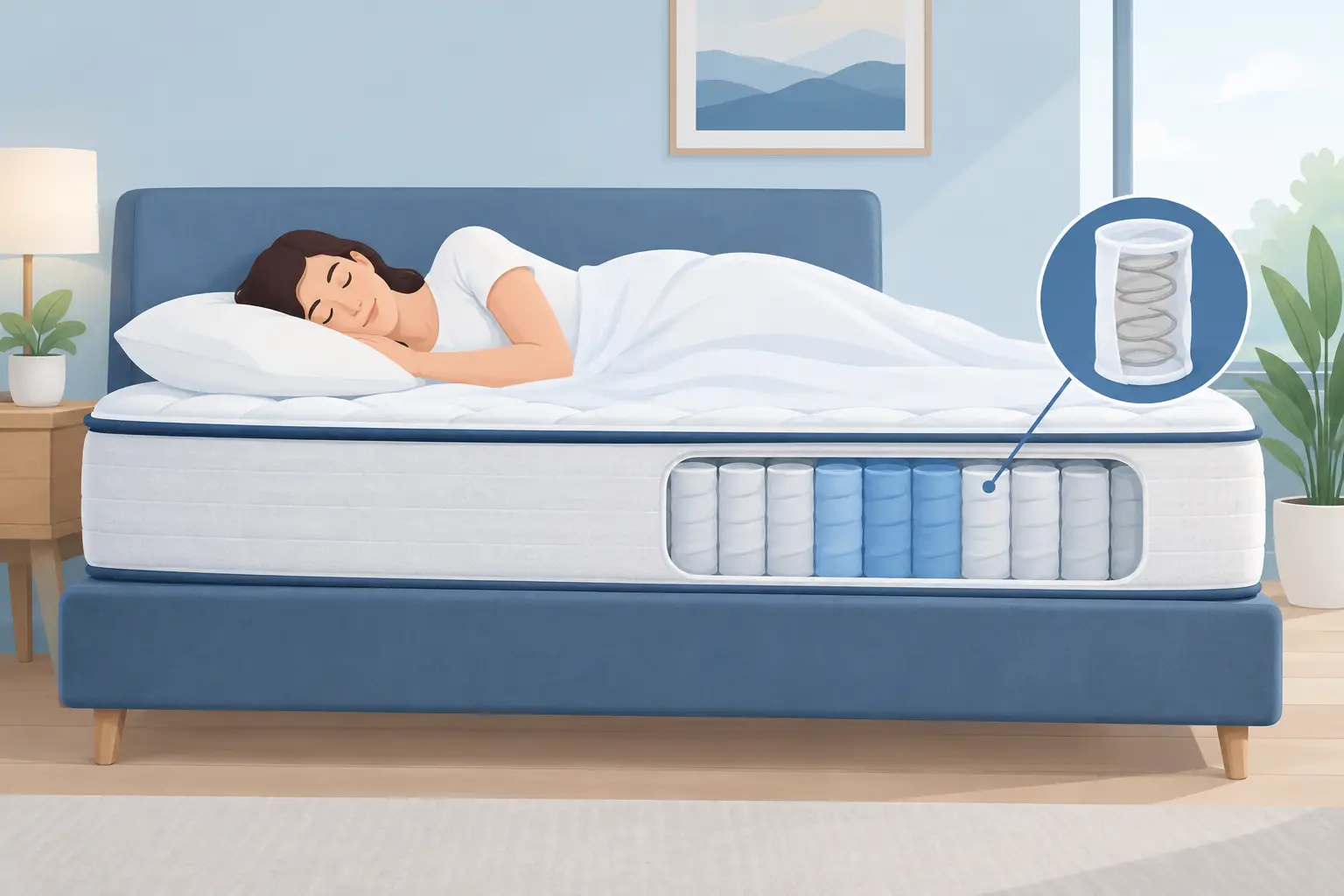
A mattress can look similar online yet feel completely different once it is on your bed. This pocket spring mattress guide explains what you are paying for, how the support works and which features are worth choosing for your comfort, room and budget.
Pocket sprung mattresses remain a popular choice for UK bedrooms because they offer responsive support without the enclosed feel some sleepers experience with all-foam designs. They are available across a wide range of sizes, comfort levels and price points, making them suitable for anything from a first flat to a family home or a furnished rental property.
What is a pocket spring mattress?
A pocket spring mattress contains hundreds or thousands of individual metal springs, each held in its own fabric pocket. Rather than moving as one large unit, the springs respond separately to pressure from your shoulders, hips and legs.
That independent movement is the main benefit. When one person turns over, the springs beneath them react while the rest of the mattress stays more stable. For couples, this can reduce the amount of movement felt on the other side of the bed. It also allows the mattress to contour more closely to different body shapes than a traditional open-coil mattress.
The springs sit below comfort layers, which may include foam, fibre, polyester, cotton, wool or a combination of materials. These top layers affect the first feel of the mattress, while the spring unit does most of the support work.
Pocket spring mattress guide: choosing the right feel
There is no single best firmness for every sleeper. Your preferred sleeping position, body weight, existing aches and the feel of your current mattress all matter. A mattress that feels supportive to one customer may feel too firm or too soft to another.
Soft and medium mattresses
A soft pocket sprung mattress has more give at the surface and can feel comfortable for lighter adults and side sleepers who prefer cushioning around the shoulder and hip. However, a very soft feel is not always ideal for heavier sleepers, as it may not provide enough support through the middle of the body.
Medium is often the most versatile choice for couples with different preferences. It provides a balanced feel: enough comfort for side sleeping while still offering support for many back sleepers. If you are replacing a mattress and are unsure where to start, medium is usually a sensible option to compare first.
Medium-firm and firm mattresses
Medium-firm mattresses are popular with back sleepers and people who want a more level sleeping surface. The feel is supportive without being as hard as a firm mattress, particularly where there are generous comfort layers above the springs.
Firm pocket spring mattresses suit sleepers who prefer minimal sink-in and need stronger support. They can work well for larger body types, but firmness should not be chosen by weight alone. A firm mattress with a thin comfort layer can feel uncomfortably hard for a dedicated side sleeper. If you often wake with pressure at your shoulder or hip, a medium or medium-firm option may be more comfortable.
Does a higher spring count mean a better mattress?
Spring count is useful, but it is not a complete measure of quality. A higher count can mean more individual points of support, which may improve responsiveness and contouring. This is particularly noticeable on larger mattresses, where there is more surface area to support.
It should not be treated as a shortcut to choosing a mattress. The quality and gauge of the springs, the depth of the comfort layers, edge support and the overall construction all affect how the mattress feels and how well it performs over time. A well-made mattress with a sensible spring count and supportive fillings can be a better value purchase than one sold mainly on an impressive number.
When comparing options, look at the whole specification. Consider the mattress depth, stated firmness, filling type and whether it is designed to be turned or simply rotated. This gives a clearer picture than spring count alone.
Consider your sleeping position and household
Your usual sleeping position gives a useful starting point. Side sleepers often need a little more pressure relief, especially around the shoulder. Back sleepers generally benefit from even support that stops the hips sinking too far. Front sleepers often prefer a firmer, flatter surface, although personal comfort remains important.
For couples, think about both movement and space. Pocket springs are a strong option when one person sleeps lightly or has a different bedtime routine. Where the bedroom allows, moving up a size can make as much difference to sleep quality as changing the mattress type. A king size mattress provides more individual room than a double, which can be especially valuable when sharing with a partner, child or pet.
For landlords and property buyers furnishing several rooms, medium or medium-firm pocket sprung mattresses are often a practical, broadly suitable choice. Select a standard UK size that matches the bed base and use a mattress protector from day one to help keep the product in good condition between tenancies.
Check the mattress size and bed base
Always confirm the dimensions of both the mattress and bed before ordering. Standard UK sizes are typically single at 90 cm x 190 cm, small double at 120 cm x 190 cm, double at 135 cm x 190 cm, king size at 150 cm x 200 cm and super king at 180 cm x 200 cm. Bed frames can vary slightly around the outside, so measure the internal sleeping area rather than relying on the overall frame width.
A pocket spring mattress works well with many bed types, including upholstered bed frames, divan beds and ottoman storage beds. The key requirement is an even, supportive base. If using a slatted frame, check that the slats are secure, evenly spaced and suitable for the mattress type. Wide gaps or damaged slats can affect support and may shorten the life of the mattress.
Mattress depth also matters. A deep mattress can create a premium look on an upholstered bed, but make sure it does not cover too much of the headboard or make the bed difficult to get into. For ottoman beds, check that the lift mechanism is suitable for the combined weight of the mattress and any bedding.
Comfort layers, edge support and temperature
The material above the pocket springs changes the feel considerably. Foam layers can add pressure relief and a closer contouring sensation. Fibre and polyester fillings often create a softer, lighter surface. Natural fillings such as cotton and wool can help with breathability, although the overall feel depends on the full build of the mattress.
If you tend to sleep warm, look for breathable cover fabrics and a mattress construction that allows air to circulate. Pocket springs naturally leave space between coils, which can offer better airflow than a dense foam-only mattress. That said, a thick foam comfort layer may still retain more warmth, so it is worth balancing the cosy feel you want with your temperature preference.
Edge support is useful if you sit on the side of the bed to get dressed, share a mattress or want to use the full sleeping width. Reinforced edges can make the perimeter feel more stable and help the mattress keep its shape. It is a practical feature, especially on a double bed in a smaller bedroom where every centimetre of sleeping space counts.
Turning, rotating and everyday care
Follow the care instructions supplied with your mattress. Some pocket sprung mattresses are double-sided and should be turned as well as rotated. Others are single-sided, meaning they only need rotating from head to foot. Regular rotation helps distribute body pressure more evenly and can reduce early dips in the areas used most often.
Use a breathable mattress protector to guard against spills, everyday moisture and dust. Let the mattress air when changing bedding, particularly after delivery, and avoid bending it sharply when moving it through stairs or tight doorways. Pocket springs are designed to flex under normal use, not to be folded.
A new mattress may feel different from the showroom or from the one it replaces. Give yourself a short settling-in period, as both you and the comfort layers need time to adjust.
Buying with value in mind
The right pocket sprung mattress is not necessarily the most expensive or the one with the highest spring count. It is the one that provides the support you need, fits your bed correctly and has a comfort level you will be happy to use every night.
At AAA Furniture UK Ltd, a practical approach is to match the mattress to the bed, room layout and budget at the same time. Choosing a suitable size, supportive base and durable comfort level makes it easier to create a bedroom that looks coordinated and feels properly comfortable from the first night.