

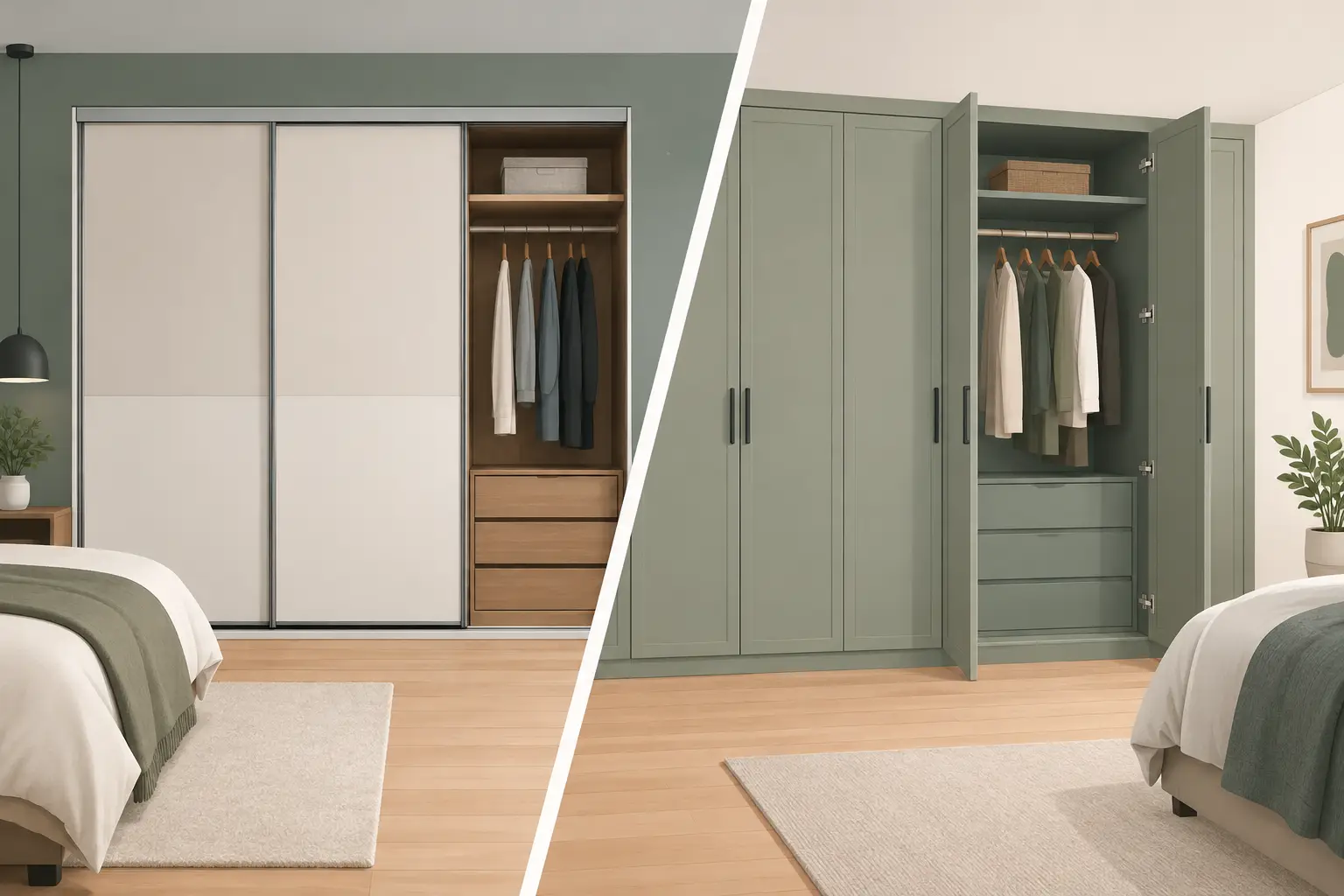
A wardrobe can look perfect online but become frustrating the first time a door catches the bed, blocks a drawer or hides the clothes you need. When comparing sliding versus hinged wardrobes, the best option is usually decided by the room’s layout, not simply by the style you prefer. Measure where the doors will open, consider who will use the wardrobe, then choose storage that makes everyday routines easier.
Start with the space around the wardrobe
The main difference is straightforward. Sliding wardrobe doors move sideways along tracks, while hinged doors open outwards into the room. This changes how much clear floor space you need in front of the unit.
Sliding wardrobes are often a practical choice for compact bedrooms, box rooms and rooms where the bed sits close to the wardrobe. Because the doors do not swing forwards, you can place furniture nearer the front of the wardrobe without preventing access. This can be particularly useful in a rented flat or a smaller family bedroom where every bit of floor space matters.
Hinged wardrobes need enough clearance for the doors to open comfortably. As a guide, check that the door will not strike a bed frame, bedside table, chest of drawers or radiator. If there is adequate room, hinged doors offer a very familiar, simple way to use a wardrobe and can suit both traditional and upholstered bedroom furniture.
Do not measure only the wall where the wardrobe will stand. Measure the depth of the wardrobe, the space in front of it and the route through the bedroom. A unit that technically fits can still make the room feel cramped if it narrows the walkway around the bed.
Sliding versus hinged wardrobes: access matters
A sliding wardrobe lets you access one side at a time. On a wide model, one door passes in front of another, so part of the interior remains covered while you use the open section. For many households this is not a problem, especially when clothes are organised by type or by person. One side can hold hanging clothes while the other stores folded items, bedding or seasonal wear.
Hinged doors give you a full view of the interior once open. That makes it easier to see every rail, shelf and drawer at the same time. If you are choosing a wardrobe for a shared bedroom, a child’s room or a rental property where straightforward use is the priority, this visibility is a real advantage.
Think about your morning routine. If you usually open the wardrobe, choose an outfit and close it again, either style works well. If you regularly sort laundry, plan outfits for the week or need to reach several sections at once, hinged doors may feel more convenient.
Consider the storage layout, not just the doors
Door style is only one part of a useful wardrobe. Internal storage should match what you own. Long dresses, coats and shirts need hanging space; knitwear, jeans and accessories benefit from shelves or drawers; spare duvets and pillows need a higher storage area.
Sliding wardrobes are commonly chosen in larger widths, which can give you generous internal capacity along one wall. Their broad front also suits mirrored panels, helping a smaller bedroom feel brighter while providing a useful full-length mirror. A mirrored sliding wardrobe can remove the need to find wall space for a separate mirror.
Hinged wardrobes can be easier to configure in practical sections. A two-door or three-door model may work well beside a matching chest of drawers and dressing table, while a taller design can make good use of vertical room height. If you prefer furniture that can be repositioned when you redecorate or move home, a standard hinged wardrobe is often a flexible option.
For bedrooms short on storage, consider the whole furniture set rather than expecting one wardrobe to do everything. An ottoman storage bed can take care of bedding, luggage and out-of-season clothing, leaving the wardrobe free for the items you use every day. This is often a more comfortable solution than overfilling shelves until clothes are difficult to find.
Style and finish in a coordinated bedroom
Sliding wardrobes tend to create a clean, continuous front. They work well in modern bedrooms, particularly in neutral colours, gloss finishes or designs with mirror panels. Their horizontal movement also gives them a tidy appearance in rooms where you want fewer doors opening into the space.
Hinged wardrobes offer more visible detail. They can suit shaker-style panels, handles, wood-effect finishes and more traditional bedroom schemes. They are also easy to coordinate with classic bed frames, sleigh beds or upholstered beds with matching bedside furniture.
Neither choice is automatically more stylish. A sliding wardrobe may suit a modern grey upholstered bed, while a hinged wardrobe can look equally smart in a contemporary finish. The better choice is the one that matches the scale of the room and leaves enough space to move around comfortably.
Think about daily use and maintenance
A well-made sliding wardrobe should move smoothly and sit correctly on its track. Keep the lower track clear of dust, hair and small items, as these can affect how easily the doors glide. It is worth opening and closing the doors carefully rather than pulling them sharply at one end.
Hinged doors rely on hinges and handles, so check periodically that fixings remain secure. A door that starts to drop or rub can usually be adjusted before it becomes a larger issue. Hinged wardrobes are mechanically simple, which appeals to buyers who want a familiar design with minimal fuss.
For households with young children, consider where fingers may be placed when doors are moving. Whichever type you choose, use the wardrobe as intended and avoid allowing children to swing on open doors or pull on handles.
Budget, delivery and long-term value
Price depends on size, finish, internal fittings and construction, rather than door type alone. It can be tempting to choose the lowest-priced wardrobe, but a better value purchase is one that fits the room properly and provides enough storage from the start. Replacing an unsuitable wardrobe after a year is rarely the economical choice.
Before ordering, check the assembled dimensions, delivery access and whether the wardrobe will need to travel upstairs or through a tight landing. Measure doorways, stair turns and ceiling height as well as the intended bedroom wall. For larger furniture orders, coordinating your wardrobe with a bed, mattress and bedroom storage can also reduce the hassle of sourcing each item separately.
AAA Furniture UK Ltd focuses on practical bedroom furniture for homes across Great Britain, with styles designed to help customers create a coordinated room without losing sight of storage and value. For landlords and housing providers, choosing repeatable wardrobe styles with durable, easy-to-use storage can also make furnishing multiple properties more straightforward.
A quick way to make the right choice
Choose sliding doors when the bed or other furniture sits close to the wardrobe, when you want a broad modern frontage, or when a full-length mirrored panel would be useful. Choose hinged doors when you have clear floor space, want to see the whole wardrobe interior at once, or prefer a traditional door-and-handle design.
Before you buy, take four measurements: the available wall width, the maximum wardrobe depth, the clear floor space in front and the route from the entrance to the bedroom. Note the position of sockets, skirting boards, radiators and windows too. These small checks prevent the most common furniture-fitting surprises.
The right wardrobe should make getting dressed and putting clothes away feel simpler, not force you to rearrange the room around it. Pick the door style that gives you clear access, useful storage and enough space to enjoy the bedroom you have.