

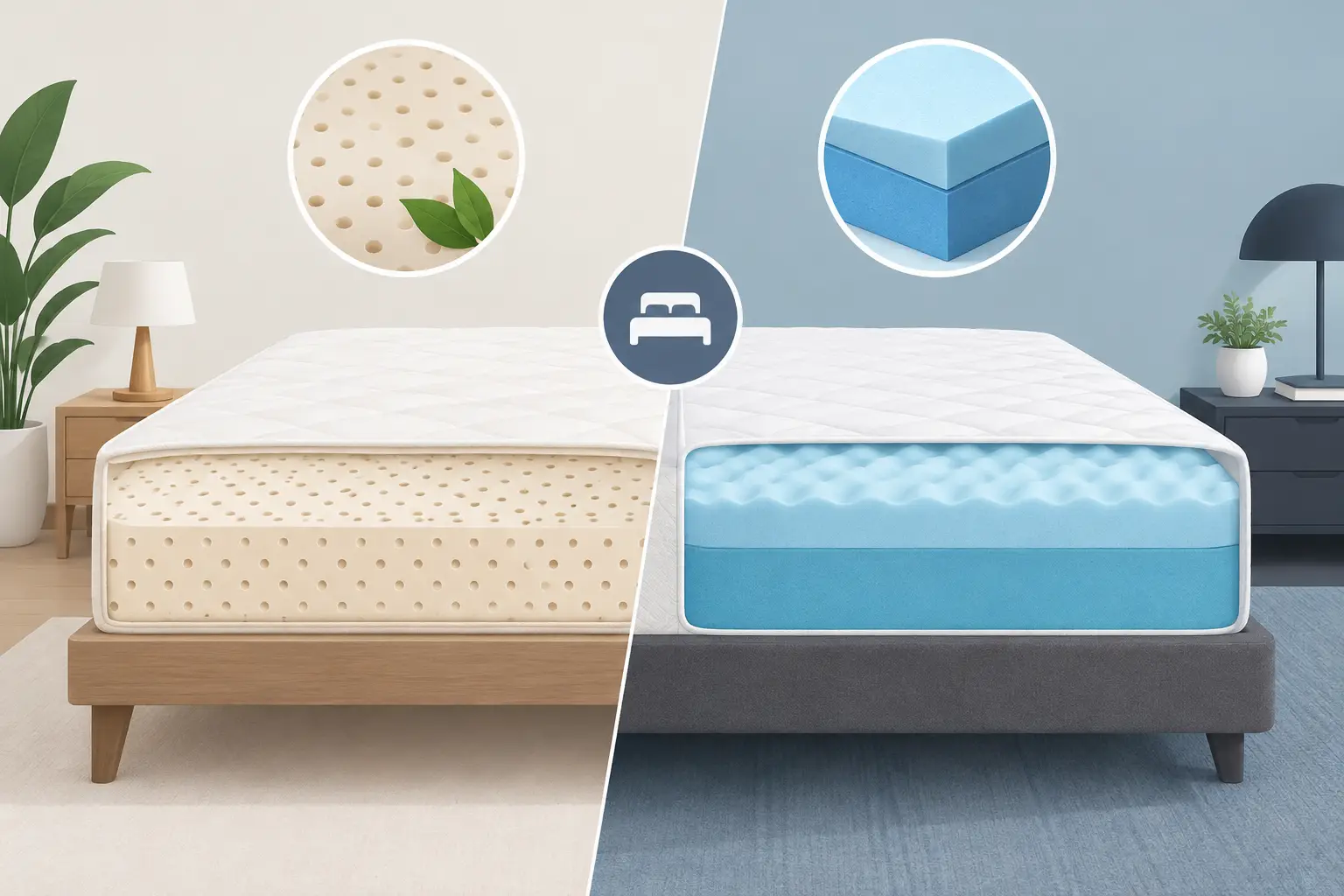
A mattress can change far more than how comfortable your bed feels at night. It affects whether you wake up stiff, whether your partner’s movement disturbs you, and how well the room works when you are choosing a new bed frame or divan. When comparing latex versus foam mattresses, the better option is not simply the more expensive one. It is the one that matches your sleeping position, preferred feel, budget and bedroom temperature.
Both types can provide excellent pressure relief and support, but they achieve it differently. Latex has a naturally springy, responsive feel, while foam usually delivers closer contouring around the body. Understanding that difference makes buying a new mattress much more straightforward.
Latex versus foam mattresses: the main difference
Latex is a resilient material, commonly made from natural rubber tree sap, synthetic latex, or a blend of both. It compresses under your weight but pushes back quickly when you move. This gives a buoyant, supportive surface rather than a deeply moulded-in sensation.
Foam mattresses are usually made with several layers, often including memory foam, reflex foam or high-density support foam. Memory foam is known for reacting to warmth and pressure, allowing it to shape around the shoulders, hips and lower back. Reflex foam tends to feel firmer and more responsive than memory foam, often at a lower price point.
In practical terms, latex tends to make you feel as though you are sleeping on the mattress. Memory foam can make you feel more like you are sleeping in it. Neither is automatically right or wrong, but that distinction matters when you get in and out of bed, turn through the night, or share a mattress.
Comfort and support for different sleepers
Your usual sleeping position should guide the choice more than any marketing label such as soft, medium or firm. Those descriptions are useful, but firmness can feel different depending on your body weight and the mattress construction.
Side sleepers
Side sleepers need enough pressure relief around the shoulder and hip to avoid tingling arms or sore joints. A good-quality memory foam mattress is often a strong choice because it contours closely to these pressure points. A medium or medium-soft feel can work well, provided there is a stable support layer underneath.
Latex can also suit side sleepers, particularly softer latex designs with a comfort layer that has enough give. However, firmer latex may feel too buoyant for someone who prefers a deeply cushioned feel.
Back sleepers
Back sleepers usually benefit from an even, supportive surface that keeps the spine in a natural position. Medium-firm latex is often well suited because it supports the lower back without allowing the hips to sink too far. A medium-firm foam mattress can work equally well, especially where the layers are designed to provide gradual support rather than excessive softness.
Front sleepers
Front sleepers generally need a firmer mattress to prevent the pelvis from dropping and placing strain on the lower back. A firmer reflex foam or latex mattress may be more suitable than a thick, plush memory foam design. If you sleep on your front only occasionally, aim for a medium-firm mattress rather than going unnecessarily hard.
Combination sleepers and couples
If you frequently change position, latex has a clear advantage in ease of movement. Its quick response makes rolling over feel natural, without the slow-moving sensation some people experience with memory foam.
For couples, foam is often excellent at reducing motion transfer. If one person gets up early or moves a great deal during the night, memory foam can help keep their movement from travelling across the mattress. Latex absorbs movement too, although usually not quite as effectively as dense memory foam.
Temperature: which mattress sleeps cooler?
A warm bedroom or a tendency to overheat can turn an otherwise comfortable mattress into a poor purchase. Latex is usually the cooler choice. Its structure is naturally more open than dense foam, allowing more air to circulate, and its responsive surface means less of the body is enclosed by the mattress.
Traditional memory foam can retain warmth because it contours closely around you. Modern foam mattresses often include breathable covers, perforated layers or cooling features, which can improve matters, but the overall feel may still be warmer than latex.
Your complete bed set-up also plays a part. A mattress on a solid base can feel warmer than one with more airflow underneath, and a heavy duvet, mattress protector or warm room can outweigh the cooling benefits of the mattress itself. For a warm sleeper, choose breathable bedding alongside the mattress rather than relying on one feature alone.
Pressure relief and aches
Memory foam is particularly popular with people who wake with sore shoulders, hips or lower back discomfort. It spreads body weight across a wider area and can reduce concentrated pressure. That close contouring can feel very comfortable for sleepers who prefer a gentle, cradled surface.
Latex also relieves pressure, but in a more lifted way. Instead of slowly moulding around the body, it cushions while maintaining a springy pushback. Some people find this more comfortable because they feel supported without being held in one position.
A mattress cannot diagnose or solve an ongoing medical condition, and persistent pain should be discussed with a healthcare professional. However, choosing a mattress with the right balance of comfort and support can make a noticeable difference to everyday sleep quality.
Durability and everyday value
Latex is generally one of the more durable mattress materials. A well-made latex mattress can retain its shape and support for many years, making its higher upfront cost worthwhile for buyers planning to keep it long term. It is also naturally resistant to dust mites and tends to recover well after regular use.
Foam mattresses cover a wider range of prices and quality levels. High-density foam and better memory foam constructions can offer dependable longevity, while cheaper, thinner foam may soften or develop body impressions sooner. This does not mean all foam is poor value. It means the quality of the layers matters more than the word “foam” on the label.
For a first flat, guest room, rental property or a bedroom refurbishment with a tight budget, a well-specified foam mattress can be a practical purchase. For buyers who want a more responsive feel and are happy to invest in longer-term performance, latex may offer better value over time.
Weight, handling and bed compatibility
Latex mattresses are often heavier than foam mattresses, especially in larger sizes. This is worth considering if the mattress will need to go up narrow stairs, be moved often, or be lifted to access storage underneath an ottoman bed. A heavier mattress is not a sign of better quality on its own, but it can affect day-to-day practicality.
Foam mattresses are commonly easier to handle and may arrive rolled for convenient access. Once opened, they need time to expand and air out before use. Always check the manufacturer’s instructions before sleeping on a newly unpacked mattress.
Both mattress types can work with upholstered bed frames, divan bases and ottoman storage beds, as long as the base provides proper, even support. Check the mattress weight against the bed’s recommended capacity, particularly with lift-up storage bases. If you are replacing only the mattress, measure the existing bed carefully: UK single, small double, double, king and super king sizes are not interchangeable.
How to choose between latex and foam
Choose a latex mattress if you prefer a responsive surface, sleep warm, move frequently during the night, or want a durable mattress with a more buoyant feel. It can be particularly appealing for people who dislike the sensation of sinking into their bed.
Choose a foam mattress if you want close body contouring, strong motion isolation, pressure relief around the joints, or a more budget-friendly route to comfort. A foam design can be especially suitable where one partner is a light sleeper and easily disturbed by movement.
The best choice may also be a hybrid-style construction that combines foam comfort layers with a more supportive core. This can offer a balanced feel, though it is still worth checking the depth, firmness, material density and overall mattress weight before ordering.
When buying online, focus on the product details rather than making a decision from a photograph alone. Look at the stated firmness, mattress depth, layer type, suitability for your bed base and any care guidance. A good mattress should fit your sleeping needs as neatly as your bed frame fits your room.
A comfortable bedroom does not need to be complicated. Start with the feel you enjoy, choose support that suits the way you sleep, and select a mattress that makes getting into bed something you look forward to each evening.